
Destination: United States
Revisiting the Verve and Glamour of the Young Jet Age
by Michael Yessis | 02.14.03 | 4:16 PM ET
Salon’s “Ask the Pilot” has a great riff on airport terminal architecture, with a focus on the beauty and fate of the Space Age terminal at New York’s JFK airport. Even if you haven’t been through the Eero Saarinen-designed building, you’ve probably seen it in the movies. Most recently, Spielberg featured it in “Catch Me If You Can.” The “Pilot” also continues a previous discussion about airplanes and Hollywood.
 Email to friend
 del.icio.us
 Digg
Digg Facebook
 Furl
Furl Ma.gnolia
 Mixx
Mixx Reddit
 StumbleUpon
 Yahoo! Buzz
Make Springsteen Albums, Not War
by Jim Benning | 02.06.03 | 4:50 PM ET
When Eric Alterman traveled to Europe to investigate the new anti-Americanism, he found that most Europeans had big complaints about U.S. foreign policy but weren’t, in fact, anti-American. Exhibit A: the Bruce Springsteen concert Alterman attended in Paris. “You can tell a lot about a continent by the way it reacts to Bruce Springsteen,” he writes in The Nation. “Tonight, at the Bercy Stadium, the typically multigenerational, sold-out Springsteen audience could be from Anytown, USA. Everybody knows all the lyrics, even to the new songs. Toward the end of the evening, Bruce announces, in French, ‘I wrote this song about the Vietnam War. I want to do it for you tonight for peace,’ and 15,000 Parisians, standing in the historic home of cultural anti-Americanism, scream out at the top of their collective lungs, ‘I was born in the USA,’ fists in the air.”
Peter Matthiessen in Alaska’s Arctic National Wildlife Refuge
by Jim Benning | 01.30.03 | 10:35 PM ET
The acclaimed travel and nature writer journeyed into Alaska’s Arctic National Wildlife Refuge (ANWR) last summer to see for himself the rugged land the Bush administration would like to open to oil drilling. In a thoughtful essay in the February issue of Outside, Matthiessen writes about his sightings of cream-colored grizzly bears, musk ox, golden eagles, polar bears and porcupine caribou. What would happen if the area was opened to drilling? For starters, the caribou “would probably calve farther to the east, producing fewer young and altering the migration patterns on which Gwich’in villages and the whole ecosystem depend,” Matthiessen writes. “And this disruption of a fragile wilderness would almost certainly lead to widespread ecological degradation.” Matthiessen’s essay isn’t available online, but the magazine’s Web site does feature many of photographer Subhankar Banerjee’s stunning images from the region, and they’re well worth a visit.
Wanna Ride the Highway to Hell? Better Hurry.
by Jim Benning | 01.27.03 | 10:58 AM ET
That’s because the good leaders of New Mexico want to change the name of Highway 666, according to a report in Sunday’s Los Angeles Times. The highway earned the name in 1942 because it was the sixth major highway to branch off Route 66. Of course, 666 is also the number of the beast in the Book of Revelation. As a result, the number is practically synonymous with Satan, who is generally considered to be an all-around bad guy.
Travel Warning: Visiting the U.S. May Be Hazardous to Your Health
by Jim Benning | 01.13.03 | 11:32 AM ET
It’s important to be aware of threats to one’s safety when traveling abroad, but take one look at the U.S. State Department’s travel warnings for a given country—or the blanket warning for the whole world—and you may never want to step foot on foreign soil again. It’s frightening! So we were happy to see Jane Engle turn the tables in Sunday’s Los Angeles Times, pointing out just a few of the warnings that foreign countries offer to their citizens about travel to the U.S.
Canada, for example, notes the potential for carjackings in Santa Monica, California. France offers tips on avoiding shark attacks. And, on a lighter note, what about fashion? “Leave it to the French to fret over fashion,” Engle writes. “Their government says Americans are tolerant about clothing but forbid even little girls to wear a monokini—the topless bikini invented in the ‘60s by designer Rudi Gernreich. Further, children must wear swimsuits and must use toilets corresponding to their gender. Mon Dieu! You can almost hear the French exclaim. Those crazy Americans!”
Duo Completes ‘Mother of All Road Trips’
by Michael Yessis | 01.10.03 | 11:38 AM ET
Andrew Kulyk and Peter Farrell recently completed what they’ve dubbed the ultimate sports road trip. During the past four years, they traveled to every professional basketball, football, baseball and hockey venue in the United States. That’s 102 arenas, stadiums, fields, domes, parks and rinks. “It was kind of a whirlwind,” Kulyk told the Buffalo News. “It all happened so quickly, and then it was over. It’s now settling in that, ‘Gosh, this is really quite an accomplishment.’”
Dave Barry Tours U.S., Feels Like Pig Farmer in Town for the Big Manure-Spreader Show
by Michael Yessis | 01.08.03 | 11:43 AM ET
Novelist, rock ‘n’ roller and syndicated newspaper columnist Dave Barry recently completed a book tour, during which he accumulated loads of rancid laundry and several hilarious anecdotes from the road. The subjects of his travel zingers: airport security and the hipster hotels booked by his publisher.
“My room had stark, modernistic furniture and several modernistic low-wattage lamps, which, when I turned them all on, provided about the same illumination as a radio dial,” he writes. “The only way to read was to turn the TV on and tune it to a program with bright colors, such as Baywatch.” Yes, these are the type of deep insights that won Barry a Pulitzer. God bless American journalism.
Cruise Ships: The New Homeless Shelters?
by Michael Yessis | 11.24.02 | 5:37 PM ET
New York City Mayor Michael Bloomberg and other local government officials are exploring whether the luxury ships tied up at city docks could be used as temporary housing for the homeless. One official says they’re “thinking outside the box.”
They’re not. It’s an old idea that dates to the 14th century Europe, at least, according to a New York Times story. It’s even been tried before in NYC. Writes Barbara Stewart: “In 1898, New York City put homeless men—or tramps, as they were called—on ships, after Theodore Roosevelt, serving as president of the Board of Police Commissioners, gave his officers two weeks to stop housing tramps in police stations.”
New Hotels for Global Nomads: ‘The Crossroads of Our Connected Yet Nomadic Society’
by Michael Yessis | 11.12.02 | 12:43 AM ET
The Cooper Hewitt, National Design Museum in New York City recently opened its “New Hotels for Global Nomads” exhibition, and the reviews are rolling in.
Christopher Reynolds of the Los Angeles Times offered a detailed piece in Saturday’s edition while last week the Globe and Mail’s Barbara Aria wrote that “the fantasy of stepping out of the you whose life you live and into someone else’s silk pajamas” permeates the show.
If, like me, you find this show potentially fascinating but aren’t going to be in New York before the show closes March 2, be sure to visit the online exhibition. The first-class multimedia presentation brings pieces of the exhibition home and showcases the Web at its best.
The Names
by Michael Murphy | 11.11.02 | 9:53 PM ET
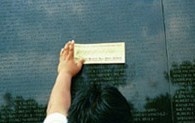 Photo by Jason Bryce.
 The Vietnam Veterans Memorial in Washington D.C. was just another stop on Michael Murphy's road trip. Then he found a name on the wall: Michael Murphy
Can Hawaii Have Tourism Without Hawaiians?
by Michael Yessis | 11.06.02 | 1:03 AM ET
At the end of my just finished two-week trip to Hawaii, I spent several days in Honolulu near Waikiki Beach. The weather was warm and people wore Aloha shrts while strolling along Kalakaua Avenue. But, for the most part, Waikiki looked and felt like Touristville, America. Theme restaurants abounded. Japanese tourists traveled in packs. And, alas, native Hawaiians were few and far between. It’s a typical phenomenon—people are drawn to a place, then the commercial rush to serve those visitors often corrupts, destroys or simply pushes out the native culture that attracted them in the first place.
Honolulu makes a fine case study, and Peter Apo of the Native Hawaiian Hospitality Association uses it in an opinion piece in Sunday’s Honolulu Advertiser. “As a people, Hawaiians are continually disappointed when we try to confront the realities of Hawai’i's contemporary visitor industry landscape,” Apo writes. “Hawai’i's hospitality paradigm is a model of exclusion of the host culture and far from the Hawaiian cultural model of ho’okipa (hospitality).”
Apo explores how modern Hawaiian tourism evolved, and how it affects locals. “It’s unfortunate that of all the players, the host communities have the smallest voice and are not necessarily the direct beneficiaries of tourism. Yet they are the ones being asked to share themselves, their families and their lives with unrelenting waves of strangers. For the most part, they have no choice but to live in tourism’s onslaught and in its wake.”
Resentment is palpable just a half-mile off Waikiki. I visited a locally owned shop, whose proprietor told me not to eat at the restaurants in Waikiki because the “food will make you sick.” She suggested I go to a Hawaiian restaurant up the street “past the evil Starbucks” or, if we had time, to drive across the island to her hometown, Kailua. That, she said, is where one can find a more laid back, friendly Oahu.
I went and had a great time. However, abandoning Waikiki isn’t a solution Apo advocates in his piece: “Not only is Waikiki not beyond redemption, but it is our kuleana as the host culture to recapture it, to take care of it, to nurture it, to be part of the solution and to respect our ancestors by not abandoning them.”
Kissing E with the Hair Band
by Mark Edward Hornish | 06.02.02 | 12:39 AM ET
 Photo illustration by Michael Yessis.
 When Mark Edward Hornish hit the road to see America, he hoped for adventure. But the last thing he expected was help from a Rock Group on Tour.
Into the Wild
by Michael Yessis | 04.29.02 | 7:03 PM ET
Peter Jenkins went to remote Alaska for 18 months to research his latest book, “Looking for Alaska.” As always, he brought along his family. Turns out the trip made a lasting impression on his daughter Rebecca. Father and daughter spoke about their experiences and motives on The Savvy Traveler this weekend. “So many of us are stuck in places because we’re afraid to leave, we’re afraid we might miss something, It’s also why so many people stay as a member of the flock,” the elder Jenkins says. “They’re afraid to step out and do something a little different. One of the reasons I wanted to have Rebecca experience Alaska was to see that she could stand alone on her own.”
Disney World: Utopian Decontextualism or Magic Kingdom?
by Michael Yessis | 04.24.02 | 7:51 PM ET
Richard Todd and his wife recently visited Florida’s Disney World for the first time, and they found certain advantages to seeing the Magic Kingdom through virgin adult eyes. “You may come here just to notch your traveler’s belt. But this is not the Lincoln Memorial or the Louvre,” Todd writes in the Atlantic Monthly’s May issue. “Monuments and museums yield their meanings readily, but Disney World is complicated. You tend to Have Thoughts. Your inner voice begins to sound like one of those hectoring French critics who can find the soul of America in a Happy Meal.”
Chasing Alexis de Tocqueville
by Jim Benning | 03.29.02 | 7:35 PM ET
What if Alexis de Tocqueville were traveling through the United States today? How would the French writer’s observations about the American character compare with those on his 1831 journey, which formed the basis of his classic book Democracy in America? Writer David Cohen, who is British and South African, set out to learn the answer and chronicled his findings in a new book, Chasing the Red, White and Blue. Cohen retraced Tocqueville’s steps, talking to Americans along the way, reflecting on equality, multiculturalism and the legacy of slavery.